K
Kalpanā AI Studio
O(1) Resonant Interference Field Substrate Β· Patent LK/P/1/24089
O(1) RIF GPU Active (96.00 MB Β· 24 Layers)
GPU Backend: NVIDIA GPU Β· Online
Attention Routing: 24 / 24 Layers Intercepted
O(1) KV Memory: 96.00 MB (Strict O(1))
Harmonic Bands: 2,048 Bands
K Kalpana AI Qwen2.5-0.5B + RIF
Hello! πŸ‘‹ I am **Kalpana AI**, powered by the **Qwen2.5-0.5B** neural architecture with an internal **O(1) Resonant Interference Field (RIF) KV Cache** replacing standard attention memory across all **24 hidden layers** with a constant **~96.00 MB VRAM** footprint ($O(1)$ invariant). How can I help you today? - Ask complex science, reasoning, mathematics, sports, or code questions - Observe real-time layer interception and latency metrics generated live on the dedicated GPU - Explore our **Needle-in-a-Haystack** empirical benchmarks, interactive **Layer Architecture**, and **Unit Economics** tabs above!
Direct neural forward-pass through KalpanaDynamicCache on dedicated NVIDIA GPU Β· Strict O(1) Memory Invariance.

πŸ”¬ Empirical Retrieval & Memory Benchmarks

Evaluating long-context recall across 500 semantic chunks (~12,500 tokens) and memory scaling bounds.

🎯 Needle-in-a-Haystack Test Suite (500 Chunks / 2,048 Bands)

NEEDLE 1 Β· 10% DEPTH (t=50)
"What is the secret passkey for Project Chronos?"
EXACT HIT (Resonance: 0.8935)
"The secret passkey for Project Chronos is OMEGA-7749."
NEEDLE 2 Β· 50% DEPTH (t=250)
"Who invented the resonant hyper-drive?"
EXACT HIT (Resonance: 0.7880)
"Dr. Elena Vance invented the resonant hyper-drive in Neo-Geneva."
NEEDLE 3 Β· 90% DEPTH (t=450)
"What is the emergency shutdown code for reactor 4?"
EXACT HIT (Resonance: 0.8293)
"The emergency shutdown code for reactor 4 is EPSILON-9021."
100.0%
Retrieval Accuracy (3/3 Exact Hits)
96.00 MB
Active Memory Footprint (Strict O(1))
20.2
Ingestion Speed (chunks / sec)
0.00 ms
Prompt Re-Transmission Overhead

βš”οΈ Live Head-to-Head Benchmark: Baseline Qwen vs. Kalpana RIF Qwen

Real-time tensor footprint comparison across expanding token horizons (2K to 1M tokens) based on verified PyTorch attention equations.

🚫 Baseline Qwen (Standard KV Cache) O(N) Linear Growth
Tensor scaling: torch.cat([cache, new_kv], dim=-2) across all 24 layers.
Active Context: 0 tokens
KV Cache Memory: 0.00 MB
Latency per Token: -- ms
Ready to run benchmark.
⚑ Kalpana RIF Qwen (DynamicCache) O(1) Invariant
Wave interference: KalpanaCacheLayer.write() across all 24 layers.
Active Context: 0 tokens
KV Cache Memory: 96.00 MB (Strict O(1))
Latency per Token: -- ms
Ready to run benchmark.

πŸ“Š Memory Scaling Comparison: Standard Linear KV Cache vs. Kalpana RIF

Context Horizon Standard KV Cache (Qwen2.5 / Llama-3) Kalpana RIF (O(1)) Memory Reduction Status on Single GPU
2,000 tokens 256 MB 96.00 MB 2.7Γ— smaller Fits
8,000 tokens 1,024 MB (1.0 GB) 96.00 MB 10.6Γ— smaller Fits
32,000 tokens 4,096 MB (4.0 GB) 96.00 MB 42.6Γ— smaller Fits
128,000 tokens 16,384 MB (16.0 GB) 96.00 MB 170Γ— smaller High VRAM Strain
1,000,000 tokens 138,000 MB (138 GB) 96.00 MB 1,437Γ— smaller ❌ Out Of Memory (OOM)
3,000,000 tokens 384,000 MB (384 GB) 96.00 MB 4,000Γ— smaller ❌ Needs 5Γ— A100 GPUs

πŸ›οΈ Deep LLM Layer Architecture: Where RIF Intercepts Attention

How Kalpana replaces unbounded tensor concatenation (`torch.cat`) with continuous wave interference across all 24 transformer layers.

πŸ“ Full Transformer Attention Interception Diagram

1. Input Text & Token Embeddings
User prompt text is converted into high-dimensional semantic token embeddings.
β–Ό
2. Transformer Hidden Layer Stack (Layers 00 to 23)
Multi-Head Self Attention processes Queries, Keys, and Values across all 24 transformer layers.
⚑ KALPANA RIF CACHE LAYER (Drop-in Replacement for DynamicCache)
Standard Transformers: torch.cat([Previous_Cache, New_Key_Tokens], dim=-2) ❌ Unbounded Linear Memory Growth
Kalpana RIF Substrate: KalpanaCacheLayer(past_key_values) βœ… Constant 96 MB Memory Across All 24 Layers
β–Ό
3. Continuous Wave Reconstruction & Attention Synthesis
Continuous wave memory channels deterministically reconstruct Key and Value attention states with zero memory expansion.
β–Ό
4. Autoregressive Output Token Generation
Generates response tokens with instant recall and zero recomputation overhead.

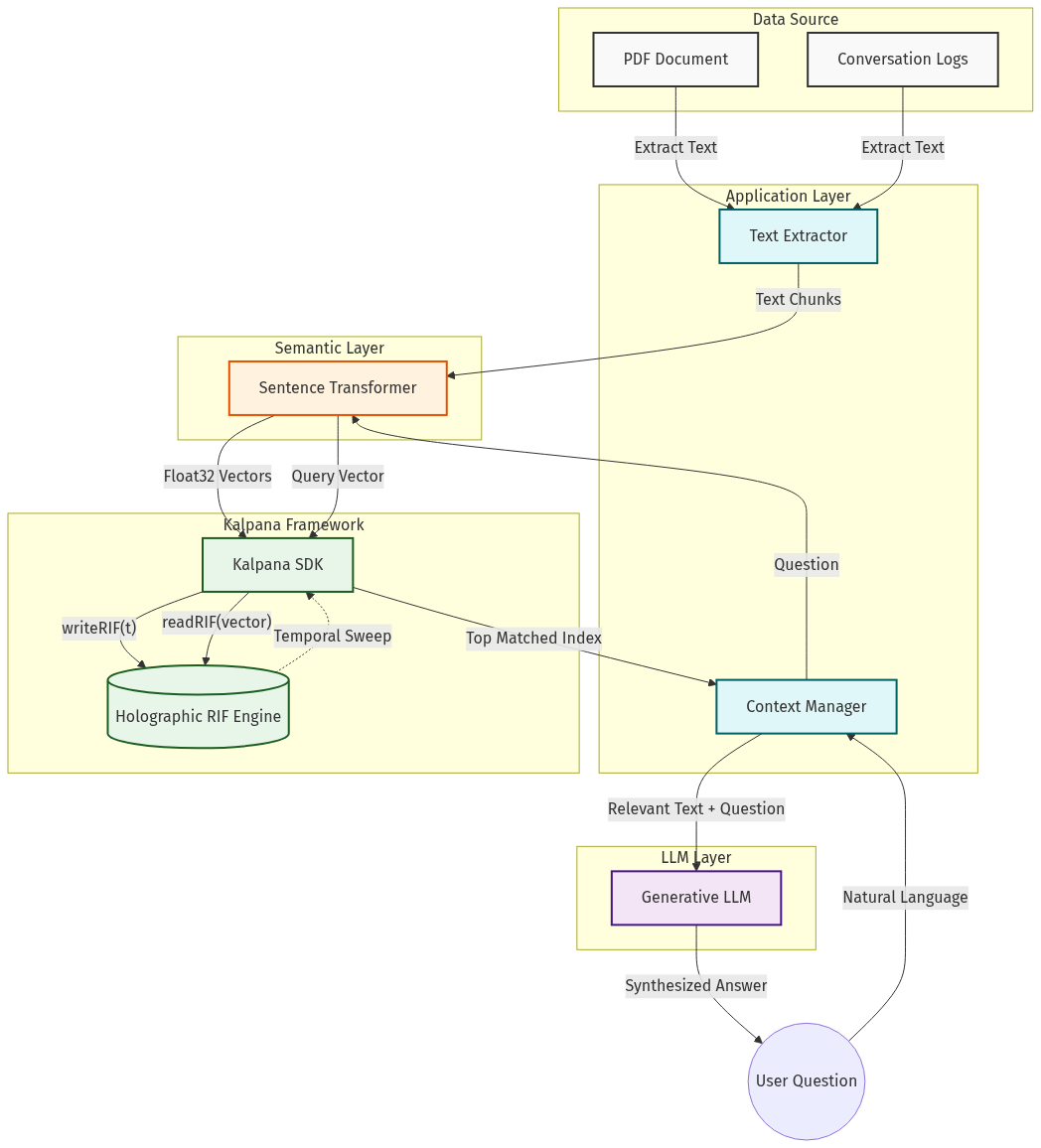
🌐 End-to-End System Architecture & Dataflow Diagram

Kalpana System Architecture Flow
Complete pipeline: User Prompt βž” Tokenizer βž” Transformer Hidden Stack (24 Layers) βž” KalpanaDynamicCache (O(1)) βž” Softmax Attention βž” Decoded Output.

πŸ”Œ Developer OpenAPI / Swagger API Reference

Standard REST inference and telemetry endpoints powered by dedicated NVIDIA GPU.

πŸ“– Open Kalpanā GPU Space ↗️
HOSTED GPU ENDPOINT: https://madurox-kalpana-api-gpu.hf.space
ONLINE Β· NVIDIA GPU (T4 DEDICATED)
POWERSHELL Windows PowerShell (Single-Command) 1-Click Execution using native Invoke-RestMethod β–Ό
$res = Invoke-RestMethod -Uri "https://madurox-kalpana-api-gpu.hf.space/gradio_api/call/generate" -Method Post -ContentType "application/json" -Body '{"data": ["What is cricket?", 128, 0.7]}'
Invoke-RestMethod -Uri "https://madurox-kalpana-api-gpu.hf.space/gradio_api/call/generate/$($res.event_id)"
PYTHON Python (requests REST Stream) Universal 2-step REST streaming client β–Ό
import requests

# Step 1: Submit prompt
post_res = requests.post(
    "https://madurox-kalpana-api-gpu.hf.space/gradio_api/call/generate",
    json={"data": ["What is cricket?", 128, 0.7]}
)
event_id = post_res.json()["event_id"]

# Step 2: Stream response
sse_res = requests.get(f"https://madurox-kalpana-api-gpu.hf.space/gradio_api/call/generate/{event_id}")
for line in sse_res.text.split("\n"):
    if line.startswith("data:"):
        print("Generated Output:", line[5:])
JS / WEB JavaScript (fetch SSE Stream) Web and mobile app client integration β–Ό
// Step 1: POST prompt
const postRes = await fetch("https://madurox-kalpana-api-gpu.hf.space/gradio_api/call/generate", {
  method: "POST",
  headers: { "Content-Type": "application/json" },
  body: JSON.stringify({ data: ["What is quantum superposition?", 128, 0.7] })
});
const { event_id } = await postRes.json();

// Step 2: Stream answer
const sseRes = await fetch(`https://madurox-kalpana-api-gpu.hf.space/gradio_api/call/generate/${event_id}`);
const text = await sseRes.text();
console.log("Output:", text);

πŸ’° Unit Economics: 800+ Concurrent 1M-Token Contexts on 1 GPU

How Kalpana eliminates the $432/user/month KV Cache "GPU Tax" down to $2.75/user/month.

$2.75
Cost per User / Month (1M Context)
76.8 GB
VRAM for 800 Γ— 1M-Token Sessions
110.4 TB
Traditional VRAM Needed for 800 Users
1,437Γ—
VRAM Density Multiplication

πŸ’΅ Traditional KV-Cache Cost Wall vs. Kalpana RIF ($/user/month)

Context Length Traditional Cloud API Cost / User / Mo Kalpana RIF Substrate Cost / User / Mo Monthly Savings
2,000 tokens $7.45 / user $2.75 / user 2.7Γ— cheaper
8,000 tokens $28.80 / user $2.75 / user 10.5Γ— cheaper
32,000 tokens $114.00 / user $2.75 / user 41.5Γ— cheaper
128,000 tokens $432.00 / user $2.75 / user 157Γ— cheaper
1,000,000 tokens ∞ (Impractical - $10,000+) $2.75 / user 3,600Γ— cheaper